Posts Tagged ‘history of swimming’

Images from SPLASH! Pool Fun

Continuing the series of posts from my new book SPLASH!

From the Epilogue: “My Watery Life”

A family triple-decker from the later half of the 1980s: I’m at the bottom, son Nathan is in the middle, and daughter Ihrie is on top. (Credit: Candy Means.)


Images from SPLASH! Jeff Farrell

Continuing the series of posts from my new book SPLASH!

From Chapter 16: “Is Enough Ever Enough?”

Six days before the 1960 Olympic trials, speed specialist Jeff Farrell was operated on for appendicitis. Here he is, less than a week later, taking the blocks in the finals of the 100-yard freestyle. The plastic-wrapped gauze bandaging his wound is sticking out of the top of his racing suit. Sometimes the best swimming stories aren’t about winning.


Images from SPLASH! Goggle Science

Continuing the series of posts from my new book SPLASH!

From Chapter 16: “Is Enough Ever Enough?”

No stone goes unturned in the search for greater speed. This sketch is from the patent application for dual-monocle goggles. Nike contends that getting rid of the strap and nosepiece will shave 0.146 seconds off the time for a 100-meter freestyle.


Images from SPLASH! Adam Peaty

Continuing the series of posts from my new book SPLASH!

From Chapter 16: “Is Enough Ever Enough?”

At the highest tier of competitive swimming, there’s barely time for anything else. The UK’s Adam Peaty, the world’s fastest breaststroker, does twice-a day-sessions in the pool and a grinding daily gym workout, all the while eating every few hours and consuming on average 7,500 calories of high-nutrition foods. The result: a perfectly sculpted swimmer’s body.


Images from SPLASH! Johnny Weissmuller

Continuing the series of posts from my new book SPLASH!

From Chapter 15: “Fastest Swimmer Ever.”

Johnny Weissmuller combined blistering speed—he swam the first sub-minute 100-meter free—with a showman’s instincts. At the 1924 Paris Olympics he took part in diving exhibitions off the 3-meter springboard and the 10-meter platform between swimming events. Later, he starred in a dozen Tarzan movies.


Images from SPLASH! Duke Kahanamoku

Continuing the series of posts from my new book SPLASH!

From Chapter 15: “Fastest Swimmer Ever.”

Hawaii’s Duke Kahanamoku, who held the world record in the 100-meter freestyle for just shy of ten years, was an ancient age 35 when he finished second to Johnny Weissmuller in the event at the 1924 Paris Olympics. Kahanomoku is more famous today as the godfather of surfing.


Images from SPLASH! World’s Fastest Swimmer (1908)

Continuing the series of posts from my new book SPLASH!

From Chapter 14: “Growing Pains.”

 
Another image from the 1908 London Olympics: Dapper Charlie Daniels, newly crowned fastest swimmer in the world after winning the 100-meter freestyle in a record-busting time of 1:05.6. Daniels trained at the New York Athletic Club, where he was also squash and bridge champion.


Images from SPLASH! Swimming at the 1908 Olympics

Continuing the series of posts from my new book SPLASH!

From Chapter 14: “Growing Pains.”

 
Swimming at the 1908 London Olympics: Competitors in the men’s 200-meter breaststroke take off from a starting platform draped with towels to prevent slipping. Winning time — 3:09.2.


Images from SPLASH! Simone Manuel & Peggy Oleksiak

Continuing the series of posts from my new book SPLASH!

From Chapter 13: “The Last Taboo.”

Simone Manuel and Canada’s Penny Oleksiak embrace after tying for first in the 100-meter freestyle in 2016, at the Rio Olympics — for U.S. women, the first-ever Olympic gold for an African-American swimmer.


Images from SPLASH! Swimming and Segregation

Continuing the series of posts from my new book SPLASH!

From Chapter 13: “The Last Taboo.”

Municipal pool, Washington, DC, 1942. Almost one in three Washingtonians were of African-American descent by the start of World War 2. All these municipal swimmers are white.


Images from SPLASH! The Backyard Pool

Continuing the series of posts from my new book SPLASH!

From Chapter 12: “Swimming Together, Swimming Alone.”
The post-WWII GI Bill helped create the suburbs, and gunite-enabled amoeba-shaped pools brought swimming to the American backyard.


Images from SPLASH! Statbad Mitte

Continuing the series of posts from my new book SPLASH!

From Chapter 12: “Swimming Together, Swimming Alone.”
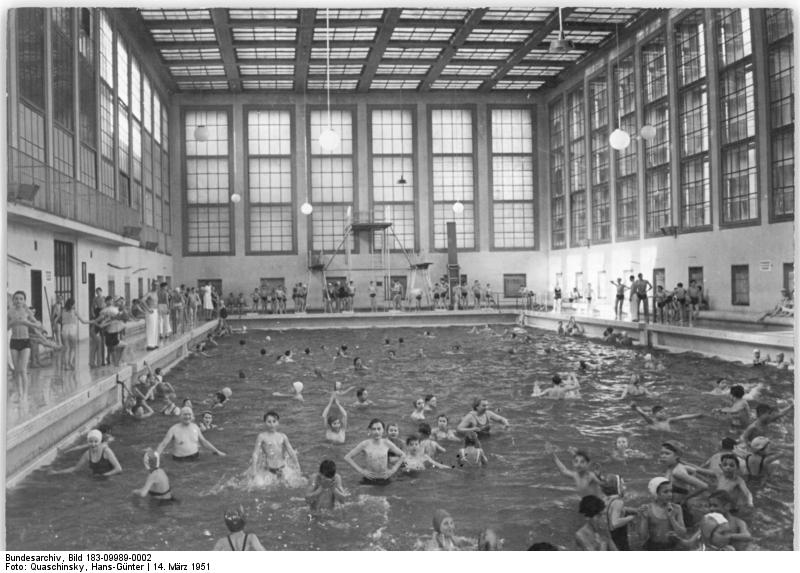
Another monster public facility from the Golden Age of swimming-pool construction: Berlin’s glass-enclosed Stadtbad Mitte, opened in 1930. Free swim, anyone?


Images from SPLASH! Community Pools from the ’20s

Continuing the series of posts from my new book SPLASH!

From Chapter 12: “Swimming Together, Swimming Alone.”

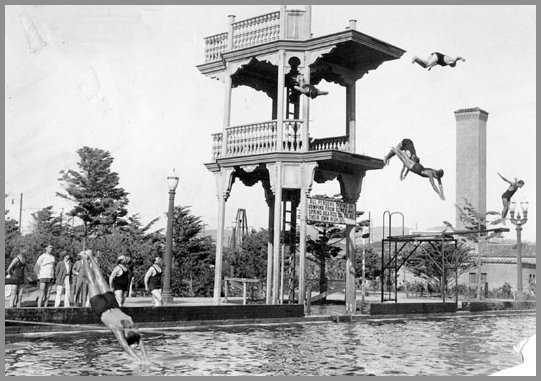
The massive Fleishhacker Pool in San Francisco, opened in 1925, billed itself as the largest heated saltwater pool in the world: 1,000 feet long, 300 feet wide, with a 10,000-swimmer capacity and a dozen lifeguards on duty on all times.


Images from SPLASH! Ursula Andress

Continuing the series of posts from my new book SPLASH!

From Chapter 11: “Nylon, WWII, James Bond, and the G-String.”

Ursula Andress, as Honey Ryder, in the very first James Bond movie, Dr. No, from 1960. Andress emerged from the Caribbean in a slim white bikini and walked into the dreams of a generation of schoolboys, myself included. (Credit: Everett Collection.)


Images from SPLASH! Nylon Racing Suit 1961

Continuing the series of posts from my new book SPLASH!

From Chapter 11: “Nylon, WWII, James Bond, and the G-String.”

The author (me) leaving the starting block at J.P. McCaskey High School in 1961. The baggy nylon suit dates the photo, but the dive dates it even more. I’m looking to land flat on the water. Swimmers today dive deeper off the blocks so they can propel themselves 15 yards (or meters) underwater, using the dolphin kick, before breaking to the surface.


Images from SPLASH! Beachwear 1915

Continuing the series of posts from my new book SPLASH!

From Chapter 11: “Nylon, WWII, James Bond, and the G-String.”

My grandfather, uncle, and mother on the New Jersey coast circa 1915. Men were not allowed to show any flesh beneath a line connecting the armpits.


Images from SPLASH! Women’s Swimming-Lib 1914-Style

Continuing the series of posts from my new book SPLASH!

From Chapter 10: “An Aussie Wrecking Ball Goes Rogue.”
Women’s swimming-lib, 1914-style: The suits were inspired by Annette Kellerman, and there’s not a matron in sight at the start of this open-water race in Sheepshead Bay, off the south end of Brooklyn, New York.


Images from SPLASH! Annette Kellerman

Continuing the series of posts from my new book SPLASH!
From Chapter 10: “An Aussie Wrecking Ball Goes Rogue.”
No one did more than Annette Kellerman to change the social history of swimming. In 1910, the head of Harvard’s Hemenway Gymnasium declared Kellerman the “most beautifully formed woman of modern times.”


Images from SPLASH! Olympics Swimwear 1912

Continuing the series of posts from my new book SPLASH!
From Chapter 9: “The Great Swimming Cover-Up.”
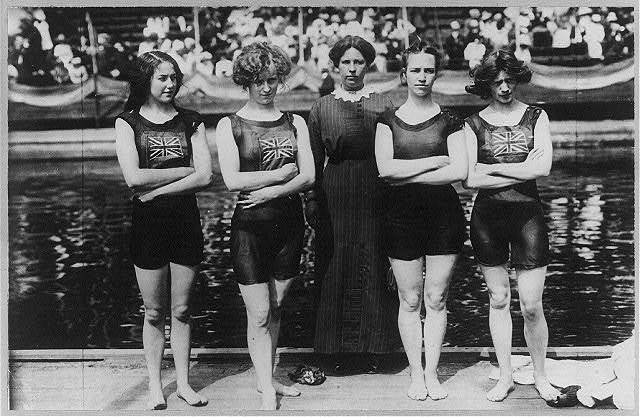
Tipping point: Great Britain’s gold-medalists in the inaugural women’s 4 x 100-meter freestyle relay at the 1912  Olympics are all dressed for the 20th century, while the stern matron behind them reminds that the past lingered on.


Images from SPLASH! Mermaids of Brighton

Continuing the series of posts from my new book SPLASH!

From Chapter 9: “The Great Swimming Cover-Up.”
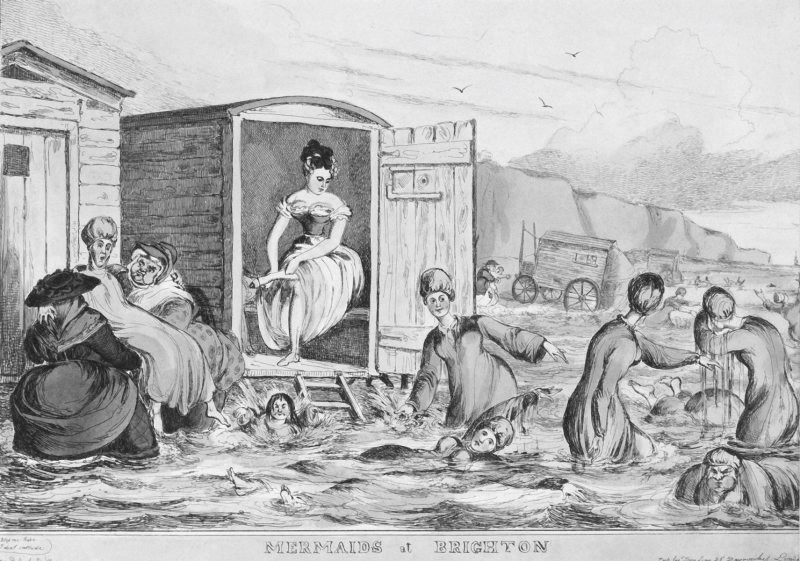
In this 1829 illustration titled “Mermaids of Brighton,” formidable older women known as dippers introduce female bathers to the wonders of the sea. The bathing machines were horse-drawn.


Copyright © 2026 Howard Means   •   This site powered by